Wednesday, October 12, 2016

Just Smile and Nod

What is it like to live in a country whose language isn't your own?

Well, let me tell you...

Imagine you are watching a movie and the audio keep cutting out. When the sound is functioning, you understand what is going on and can hazard guesses as to what will happen next or where the action will logically flow next. When the sound drops, you have to guess what's happening based on facial expressions, hand gestures, bodily movement. But when the audio cuts out during one scene and returns during another, you find yourself mentally scrambling to find the context so you'll understand just what in the hell the characters are talking about.

Sometimes you understand 100% of what is going on and sometimes you are lost.


 When all else fails, just smile and nod.

That's how it is for me in Chile. Luckily I have a decent grasp of the Spanish language. But even so, there are times when I find my brain turning off, so to speak, and my thoughts wondering. I think those must be mental breaks that I subconsciously give myself - because anyone who's been in a foreign country knows: thinking or translating another language is exhausting!

My experience with Spanish began almost 17 years ago when I first met Mark. I took two years of Spanish in college but the classroom setting wasn't very helpful for my learning style. It wasn't until I studied abroad in Granada, Spain that I began to really speak Spanish. Total immersion is the secret. It was a little daunting, I'll admit, but if something isn't a little challenging, then where is the excitement in that?

In Spain, I attended the Universidad de Granada and took Spanish language classes in Spanish with no English translation - nada. I went on every planned excursion and also traveled on my own and with friends. My friend, Lauren, and I made a deal with each other - whenever we went out together, we would take turns speaking. This buddy system really helped boost our confidence. We were there to help each other out but at the same time, we gave each other the practice we needed. I highly recommend this approach to anyone studying abroad.

 El Centro de Lenguas Modernas, Granada (Photo Credit)

I continued my experience with the Spanish language through Mark. Being around Spanish-speakers helps tune one's ear to the language. After awhile you are able to identify common sounds and phrases and yes, even curse words. When my mother-in-law visited or when we went to Chile, of course, I got more practice. This periodic experience was helpful but I'm in no way fluent because of this.

"Semi-fluent" would be the best term for someone like me. Fluency means accuracy of expression, both in writing and speaking. When I speak Spanish, I'm sure I sound like a cave woman. I drop my verb endings, mix tenses, and sometimes grunt when I can't think of a word. As for reading and writing, my Spanish is so-so. The plus is that when I need to write in Spanish, I usually have time to think about what I want to say and even look stuff up. When talking, there is an immediacy which means sloppy Spanish.

Anyway - no pasa nada - don't worry about it. I'll learn more and get better as the days pass.

Tuesday, October 11, 2016

Cafe Panache and the 10th Street Supper Club

Back in August, we had reason to be in downtown Greeley. Feeling peckish, we wandered into Cafe Panache off of 10th Street. It was cozy and dark but welcoming all the same. Mismatched chairs sidled up to ornate wooden tables. In the back, the chef was in full sight behind the counter, whipping up crepes savory and sweet. We ordered the special of the day, watermelon gazpacho, and two savory crepes - turkey pesto and sage chicken - to share alongside espresso granitas. Everything was delicious.


It was also our good fortune that day to notice a poster pasted onto the window for the 10th Street Supper Club. Mark brought a small flier over to our table and the chef, who served us, encouraged us to come.

Founded just over a year ago, the 10th Street Supper Club was the creation of neighboring businesses - Cafe Panache and owner Chef Roger Brindisi, and the Cranford Cove Tea House and owner, Aaron Wooten. The idea behind the supper club was to create a seasonally-inspired tasting menu that would be offered one night only. The limited number of seats must be reserved in advance and guests would be treated to a multiple course meal above and beyond casual cafe fare.

My tattered flier

The upcoming dinner was inspired by one of America's favorite summer past-times, grilling out. So of course, we bought two dinner and wine pairing seats for the 8pm seating. Luckily, my wonderful mother was able to watch Oli for us and the two of them made the night into a fun sleepover. 

Meanwhile, Mark and I dressed up for our special date night, prepped the new camera, and made sure we had ink in our pens.
Mark greeting Chef Roger in the Tea House

We arrived around 7:45pm and were welcomed into the Tea House. There were four community tables from which to choose. We grabbed the last two seats at one table and introduced ourselves around the table. The other early arrivals were mostly Greeley professionals from varied fields from finance to local government. About two thirds of the guests had attended the Super Club before and only a handful were new to the experience.

Aaron answers questions about the meal

Once everyone arrived, the feast began. As the first plate was served, Aaron explained that we were in for a culinary treat - a world tour of grilling. He introduced his fellow Super Club organizers, Roger from Panache, Tony - a level three sommelier, and Chef Toryus Thompson - the designer of  the night's menu.

Tony moved from table to table, filling champagne glasses with a nice dry cidery bubbly (Andre Brut) while Aaron and Roger served an amuse-bouche* skewer of chicken hearts drizzled over top with a tangy cilantro sauce drizzled and cilantro garnish. Now, I'll admit, the idea of chicken hearts didn't really appeal to me. I have here-to-fore never eaten organ meat. But, as this was a special occasion, I decided to give them a try. After all, my personal mantra is "Try everything twice." Turns out they were pretty tasty. I wasn't overly thrilled with the valvy-texture, but that's a personal thing and I can definitely say that Chef Toryus made chicken hearts quite delicious.

*An amuse-bouche is a small bite served before the meal and isn't considered an hors d'oeuvre. Rather, it is a gift from a chef to "amuse the mouth," a term taken from French Culinary tradition. It is meant to treat guests to a preview of the chef's skill and tastes and is typically not on the menu.

 Amuse-bouche: chicken hearts with cilantro sauce

Chef Toryus describes the amuse-bouche. "Pretty much within hours of giving the humans fire, there was a world-wide tailgate party."

While we ate, Aaron gave us a little historical perspective. "Skewered meat goes far back into the recesses of human history. Ancient peoples used geothermal-heated waters for cooking meat on sticks. In fact, in our own country's history, Lewis and Clarke ate skewered meat on sticks, using hot springs discovered along their route. At one point outside Jackson, Wyoming, the Corps of Discovery were forced to eat a couple of their dogs that way." (While fact-checking this, I discovered that dogs were eaten on numerous occasions by the expedition.)

Moving onto Japan, 3rd level Sommelier, Tony, made the rounds with a bottle of chilled sake. Enter Sake from the Black Dot series, is a boutique sake curated by musician Richie Hawtin. Fermented primarily in cedar for 6 weeks, the Black Dot series goes one step further and allows the sake to mature in oak. This makes for a complex flavor that is "masculine on the palate." To me, the sake had a floral taste, but what do I know?

The first course continued the theme of skewered food, but departed in that it was vegetarian. In Japan, skewered food is called Yakitori. Our veggie yakitori of rolled carrot, zucchini, sweet pepper, mushroom, red onion, and tofu was served over a bed of smoked basmati rice, topped with a honey soy glaze. This glaze was amazing! It perfectly suited the dish and made me wish there was more than one skewer on my dish.

Aaron serving the yakitori

First course: Yakitori over smoked rice

The second course began with Tequila Sunrises made with mezcal. In the event you don't know, mezcal is like tequila, except for the worm which mezcal has and tequila doesn't. Mezcal is made from the fermented mash of the agave plant and has a strong smoky flavor. Regarding mezcal, there is a saying from Mexico which goes something like this: "Para todo mal, mezcal. Para todos bein, tambien" (translation: For anything bad, mezcal. For anything good, [mezcal] also).

Luckily, there were no worms in my glass because that would have knocked me on my rear for the rest of the evening. As it was, the drink was very strong and I found that I could not finish it.

Soon after toasting our mezcal sunrises, the second course was served. Continuing south of the border for culinary inspiration, we were served zesty barbacoa tacos. Shredded beef and pineapple spooned over white corn torillas, these were likewise pretty spicy. A lime-coconut aoili added an additional layer of zest. Looking around the room, I concluded that this was a favorite dish so far.

Plating the tacos with Panache 

  The beef was smoked for 10 hours prior to the service.

For the third course, we were treated to a nice glass of Lady of the Mandrake Cabernet Sauvignon. Although I love to try new things, I must admit, there's nothing quite like a decent glass of tinto. Tony explained that the robust red fruits played well with the dark roasted brisket that we were about to be served. And boy, was he right!
Tony extolling on the virtues of red wine
 
Plating the brisket on wooden trenchers


I was in love with this course!

Returning to the US with the third course, Texas brisket was served alongside beans and a deconstructed potato salad. The Kansas City barbeque sauce was the perfect complement to the plate. I don't think I've had brisket this delicious in a long while. I probably could have eaten three portions of that succulent treat! Even though I thought the beans were a little dry, that couldn't distract me from how good this course was. My table-mates all agreed that this was utterly scrumptious (there's some professional lingo for you).

The final course was served with what Tony referred to as his "favorite mistake of the 19th century." This sweet wine is made by mixing the current year's fresh grape juice with the previous year's cognac. The result is a fresh, bright wine with an underlying heady sweetness. Very very good.

I'm in full agreement with Tony on this one.

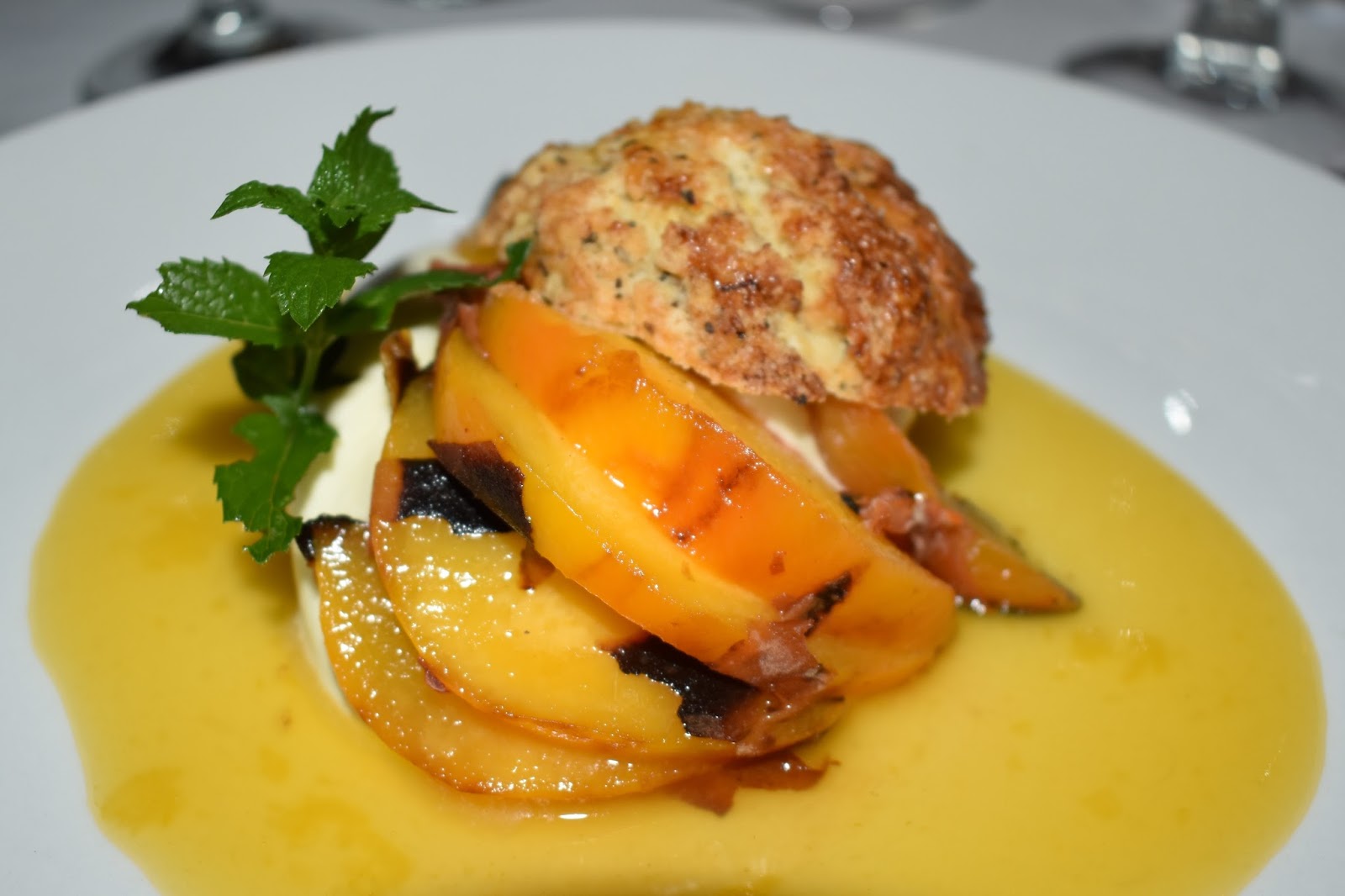
At this point, I was feeling on the verge of overflowing with drinks and food. But alas, there was one more course to be served. Dessert was grilled peach served over a basil shortcake, topped with sweet cream, mint garnish and a mango gastrique. Holy Peaches! Even though I was certifiably almost ready to pop, I practically licked my plate clean. The sweet wine perfectly complemented this decadent finale. For the first few moments after being served this dish, the room was practically silent as all the guests savored the final treat. It was a hit all around. What a way to finish the evening. 

Peaches right off the grill

Holy peaches!

If I had to rate this evening on a scale of 1-10, I would certainly give these folks a 9. Everything was delicious and satisfying, with only a few minor technical errors such as killer mezcal and dry beans. There was more than enough food and drinks to whet my appetite. The company was likewise pleasant and the atmosphere cozy and comfortable. I would highly recommend both restaurants and the 10th Street Super Club.

The hosts toast to an evening well done.

Wednesday, September 28, 2016

What does this Expat Writer do all day?

Curious about how I fill my hours?

Keep in mind that I've only been here just about two weeks, so I'm not quite settled. I am still living in the house of my sister-in-law, but some semblance of normalcy is beginning to assert itself - to my relief. After being a gypsy for four months - living in my mom's house, camping outdoors, and now living with my sister-in-law, I'm eager for some sort of daily rhythm to assert itself.

So, here's what I do: During the traditional work week, Monday through Friday, I follow a simple routine. During the mornings, I homeschool Oli - right now we are only doing one subject because our shipping container has not arrived yet and I only have reading materials with me. After a late lunch, she plays for a bit before we out the door to walk to her school which is about 5 blocks away. In the afternoon, she attends a Waldorf kindergarten for four hours, 2-6 pm. During that time, I work in the cafe below (same building).

My afternoons usually look like this.

My work includes updating my blog, social media, researching the publishing markets, writing our cookbook sections and recipes, writing my fiction (both short and long forms), and writing freelance articles. Some days I focus on just one or two things and other days I'm all over the place. But I always set goals for myself of what I want to accomplish each day. As a self-employed writer, it is important to be aware of time and how I spend it.

After Oli's school gets out, we usually walk back to the house and have dinner together. There is some play time afterwards and before bedtime. And of course, stories to be read before tucking ourselves into bed. I am currently reading Harry Potter and the Sorcerer's Stone to Oli. After Oli is asleep, Mark and I usually hang out with Luz and Cristian, drinking the occasional beer or wine and munching on ceviche, empanadas, and other tasty Chilean snacks. Bedtime is late in Chile - around midnight - and you bet I always make time to read before I drift off to sleep.

Saturday, September 24, 2016

Ode to the Choripan


Ode to the Choripan
Oh! Good God!
Your crisp skin, blackened to a crunch
Holding inside, juices and heat and 
flavor too great for so small a shape.
Entire universes wish they burst 
so like a bite into your flesh.

This delicious little sausage tucked lovingly into a crispy bun is the Chilean prerequisite to a bar-b-q. In fact, no asado - or "Chilean cookout" - is really complete without them. Typically, you put all the meat on the grill at the same time and naturally, these little guys cook faster than a rack of lamb or a large cut of meat. When they're ready, charred black and blood red, you pop a couple of marraqueta buns onto the grill until they are warm. Then, slipping the greasy little sausage into the bun, sans condiments, you consume them while they are hot, often burning the inside of your mouth in the process. But it's worth it.

Marraqueta bread - break them in half along the seam and you can chow down on two!

 Crackling skin means they are ready.
Fresh off the grill, these flavorful sausages are waiting for their buns.

Chilean chorizo is completely unlike the Mexican and Spanish varieties. It is not very spicy and it isn't at all dry. Unfortunately, we've been unable to find them in the U.S. which means that at some point later on, we'll need to experiment with making them ourselves. We had great success making our own sausages this past New Years. We just need to hit upon the right combo of meats and spices.

Choripan, an excellent accompaniment to a good beer or glass of bubbly.

You'll find different varieties of choripan in other South American countries: Argentina, Bolivia, Uruguay, and Paraguay, to name a few.

Fun Fact: Beloved Chilean poet, Pablo Neruda, loved a stew so much that he wrote a poem about it, entitled "Oda al Caldillo de Congrio," or "Ode to the Congrio (eel) Stew." You can read this famous poem here.

Tuesday, September 20, 2016

Picture Perfect, Part 5

Here are some photos taken with our Macro lens. This lens is quickly becoming one of my favorites. It allows a view into a world not often seen by the naked eye.

Tokina AT-X M100 AF Pro D
When researching this lens, I came across this great article, The First Nikon Lenses You Should Buy, on thewirecutter.com. Not only does this article explain some basic principles behind the different lenses, but it also provides a range of prices to choose from. Because this type of lens was heartily recommended for food photography, I went with the top choice for the Macro lens.


See the other posts in this series:
Part 1 – Camera Research
Part 2 – Camera Purchase
Part 3 – Zoom Lens
Part 4 – Fast Prime Lens

Monday, September 19, 2016

El 18 de Chile - Day Three

And so we celebrate on...

Day Three
To me, these continual parties feel like every time we come in town - Mark's family and friends throwing cookouts left and right. So thankfully, a cookout at home on day three.

Today we enjoyed...drumroll...more meat! Lots of cuts of meat and yummy salads. Oh and did I mention the drinks? This no longer surprises me, but there was a point in time - probably when Mark and I were first dating - when I could never imagine the amount of casual drinks a Chilean could put back (and yes, without becoming ass-to-the-ceiling drunk).

Let me give you a theoretical example. An asado begins with a beer or a pisco sour (a deceptively delicious lemony cocktail). While the meat is on the grill, I am typically offered another beer or pisco sour at least three times. At the start of a meal, we may toast with another drink entirely - let's say champagne. Then with the meal, more beers and now wine as well. Afterwards, I am offered more wine or perhaps I'd like a whiskey? Needless to say, at this point, I'm usually all about the coffee.

 Toasting with Cristian C
 A tasty honey beer
 
Guess who's at the grill again today? That's right...Mark.

We were joined by our neighbors, Rodrigo and Daniela and their three boys. 

FUN FACT: Rodrigo shared with me that September 18th wasn't actually the day that Chile won its independence from Spain. That happened back on February 12th. So what was so important about the 18th? Well, that was the day (in 1810) that the whole war for Independence thing started and on February 12th (of 1818), the declaration was issued. Those stubborn conquistadors, however, refused to recognize Chile's independence officially until 1844. The government selected the day of the 18th to celebrate the country's independence, and the 19th to celebrate the military.
My full plate. Can we say satisfecho!

To see what transpired on the other days of celebrating Independence in Chile, go here:
 

Sunday, September 18, 2016

El 18 de Chile - Day Two

As mentioned before, Chileans celebrate their independence like no other nation I know. Although one day is listed as the specific holiday, they close up shop and throw parties for at least three days straight.

Day Two
Today we took it easy and headed over to Cristian C's house for family asado.

 The festivities commence when the barbeque is lit! As the grill heats up, Chileans clean and season the grill by rubbing an onion vigorously across the cooking grid.

Oh yes, those adorable little sausages on the right - chorizo for choripan! 
 This is what I'm talking about!
Fiestas are time for old friends to reconnect over some tasty grilled meats... (Cristian C and Mark)

 ...and of course, time to make new friends. (Oli and Cristian's beautiful daughters)

 No matter the country, Mark always finds himself at the grill.

 Oli is in full fiesta mode, sporting the traditional dress of the Chilean Cueca.

Shredded carrot and lettuce salad with lemon vinaigrette.


 Ensalada Chilena, the "official" salad of Chile. Offered up at nearly every fiesta as a popular side dish. We ate this a lot in the U.S. and it's pretty simple to make.  

Here's how: Slice up a yellow onion fairly thinly and blanch in boiled water for a few minutes. This takes the pungent bite out of the onions without loosing the savory flavor. Shock the onions with cold water after they become slightly floppy but haven't lost all their crunch. Slice a tomato or two and toss with the onions. For dressing, simply drizzle over a tablespoon of olive oil and add a pinch or two of salt. Minced cilantro or oregano make nice additions if you want a little more punch.


Diced carrot and potato salad dressed with mayonnaise (Disclaimer: Chileans LOVE mayo and you will see it a lot in this blog.)

To see what transpired on the other days of celebrating Independence in Chile, go here:

Saturday, September 17, 2016

El 18 de Chile - Day One

In Chile, Independence Day is a big deal. Although the 18th is the official holiday, most businesses are closed and families celebrate for several days. Our celebrations began on the 17th and continued until the 19th.

Day One
We kicked off our celebrations by attending a feria (or fair) at a local park. There was food aplenty, music, dancing, farm animals, and artesanias (or crafts).

 Oli looking at the lambs.
 Literally, "Farm Education"
Los caballeros, cowboys
 Traditional food on display. Of note, the clay pot in the center is Pastel de Choclo, a savory casserole-type dish made with beef, chicken, and veggie filling and topped with corn puree. 
 If you haven't figured this out yet, Chileans are all about meat.
 This terrific poster translates to "The Fountain of Meat."
 Artesanias, or hand crafts, are very popular in Chile and not too expensive. You can buy a quality sweater for only 5 bucks!
This adorable Chilean family watches the dances up on stage (in the very far distance - so far that I could not get a good photo.)
 Mountains of sweets to enjoy
 More from the fountain of meats

 My sister-in-law, Luz, and my nephew.

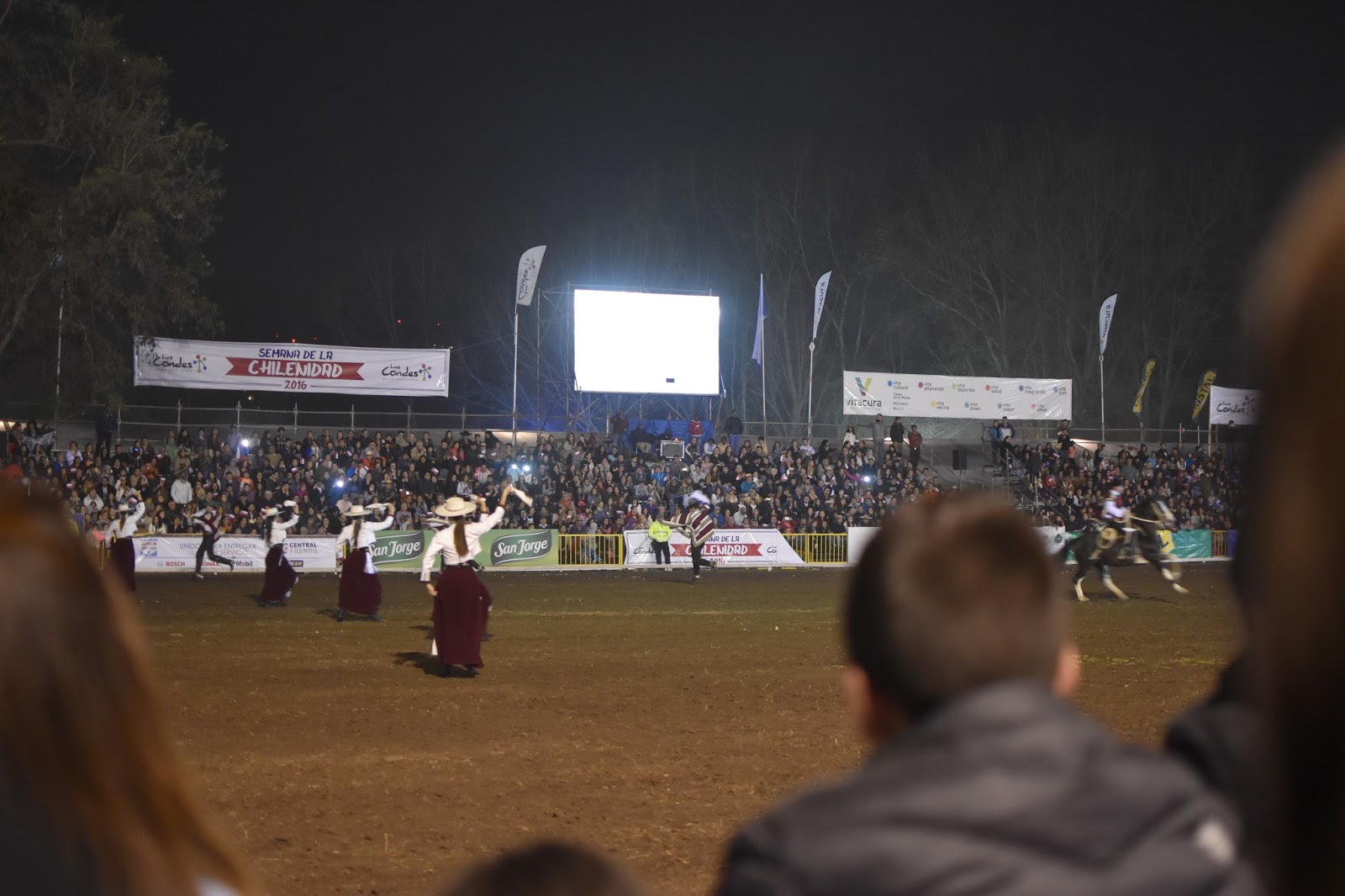
 Central to everyone's attending was the arena where there was showcased the dances and "cowboy feats" representative of the different regions of Chile, complete with elaborate costumes and music.
 This dude was literally climbing all over his horses and swinging beneath them at full gallop.
A badly taken photo of La Cueca, the traditional dance of Chile. This dance is so integral to Chile that every child learns this in school and there are even dancing schools specifically devoted to its mastery.

 Mark and Oli dancing.
A happy group of teens dancing La Cueca.
Flashback: My other sister-in-law and my nephew dancing La Cueca at my wedding.
 The night ended with fireworks, which I found out is not typical of Independence Day festivities. Instead, fireworks are mostly associated with New Year's Eve.
The Chilean Caballero

To see what transpired on the other days of celebrating Independence in Chile, go here: